

The Gray Legacy 100+ Years of Quality Service!
The Gray family’s American manufacturing story began in 1893, when William Gray moved his family from Ontario, Canada, to Rochester, New York, after emigrating from Scotland. Three of his sons, Malcolm, William H., and Daniel, learned the stamping trade at Rochester Stamping Company before founding Atlantic Stamping Co. in 1903.
Over the next century, the Gray family pioneered advancements in metal products manufacturing, including the establishment of Rochester Can Company, where Malcolm Gray implemented the five-day work week later popularized by Henry Ford. William H. Gray and his sons went on to establish Gray Metal Products, Inc. in 1932, specializing in sheet metal ductwork and building a reputation for innovation and quality.
Through each generation, the Gray family grew its companies with a dedication to craftsmanship, patented innovations, and family leadership. Today, multiple Gray-owned companies—including Gray Flex Systems and Snap-Rite Manufacturing—continue this legacy across the HVAC industry.
Gray Family
Legacy Timeline
1893
William Gray moves his family from Ontario, Canada, to Rochester, NY.
1894-1903
William Gray’s three sons – Malcolm E., William H., and Daniel D. Gray learned the stamping/tinware trade at the Rochester Stamping Company.
1903-1908
- In September 1903, Malcolm E., William H., and Daniel D. Gray founded Atlantic Stamping Co. in Rochester, NY.
- Starting in a small room with 2-3 second-hand machines making oil and gas cans. Expanded early product line to include wash boilers and dairy pails due to customer demand.
- Rapid success attracted interest from Rochester businessman W. J. McKelve, a man well known in the Masonic circles.
- Partnership formed between McKelvey and the Gray brothers and the business rapidly grew, requiring expansion to a larger building and more equipment.
- Product offerings grew to include cups, dippers, dishpans, cream pails, cream separators, galvanized wash tubs, and other goods.
- Atlantic Stamping Co was incorporated and McKelvey brought in multiple investors to secure capital for company stock.
- The infusion of investment capital helped build a state-of-the-art 52,804 sq. ft. manufacturing facility on Ames St. in Rochester, NY.
- Malcolm and brother William file several patent applications for various metalware items resulting in 2 jointly issued patents and 5 individually issued patents (Patent#’s 796,717; 893,321; 890,640; 893,484; 880,522; 876,633; 884,485).
1908 - Rochester Can Company
- The Gray brothers decide to sell their interest in the Atlantic Stamping Company, sending the three brothers on different career paths.
- Malcom E. Gray founded Rochester Can Company and named Daniel D. Gray as superintendent.
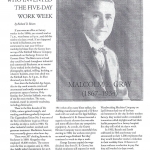
- Rochester Can Company is founded to produce items under the IRON HORSE trade name that are in direct competition with Atlantic Stamping Co.
- In January 1922, Rochester Can Company achieved recognition for the founding and implementation of the Five Day Work Week. Later adopted by Henry Ford and erroneously credited to Ford.
- 1930 – Daniel D. Gray, superintendent of Rochester Can Company died after a long illness on August 29, 1930.
- 1932 – Malcolm E. Gray, founder of Rochester Can Company died of pneumonia, November 7, 1932. Prior to death, Malcolm turned over control of Rochester Can Company to his two sons in law, Rodney S. Hatch and William Easton, on April 25, 1930.
- Rochester Can Company was eventually sold to outside investors in 1951 and within 8 years of being sold was declared bankrupt and liquidated by September 1959.
- This ended the entrepreneurial involvement of descendants of Malcolm E. Gray and Daniel D. Gray in the metal goods industry.
1908 - William H. Gray
- William H. Gray pursues a career path which leads him into another metal related trade and starts a contracting business dealing with the public as a sheet metal tradesman.
- William offered comprehensive tin, copper, and sheet iron work, with furnace heating as his specialty. His services included general jobbing and repairs, cleaning and repairing furnaces and stoves, painting conductor pipes, and providing a wide range of custom specialty work.
- William serves as an agent for underground garbage cans produced by the Rochester Can Company.
- He buys out a competitor and continues working as a contractor for roughly 18 years.
- During this period, he expands into gutter-related products and files patents for a stove pipe and gutter end cap.
- He received two patents in 1921 and 1922 (U.S. Patents 1,373,883 and 1,437,937).
- By the mid-1920s, he was operating as William H. Gray & Son’s with his sons William J. and Donald E. Gray.
- The business, located at 20 Beacon St., Rochester, NY, manufactures furnace elbows, nestable furnace tees, gutter hangers, gutter caps, gutter outlets, and sheet metal ductwork.
1932-1933
- In May 1932, Gray Metal Products, Inc. was incorporated.

- William H. Gray and his wife Emma become majority stockholders; sons William J. and Donald E. hold minority shares.
- Assets of William H. Gray & Son’s are sold to the new corporation for $1,894.16, including 14 presses, an elbow machine, and 54 dies.
- William H. and William J. Gray applied for two patents, resulting in one joint and one individual patent (Patents 1,848,947 and 1,903,861).
1941
- William H. Gray receives two patents for an eave trough hanger and a duct joint construction (Patents 2,233,049 and 2,260,221).
1942
- William J. Gray received a patent for a duct joint (Patent 2,274,785).
1953
- William J. Gray received a patent for a snap lock for pipe (Patent 2,264,761).
- June: Donald E. Gray sells his interest in Gray Metal Products, becoming essentially a silent partner prior to the sale.
- Gray Metal Products, Inc.evolves as a full line pre-fabricated sheet metal air duct manufacturer and establishes a reputation for providing high quality air duct products throughout the New York, Pennsylvania, and New England regions.
1955
- William H. Gray dies; William J. Gray assumes full control and operates two facilities: Rochester, NY and Webster, NY.
1958
- Gray Metal purchases the first Welty Way “Colatch Machine” for attaching collars to fittings automatically. Delivered personally by Mr. Welty, marking the first machine ever sold by the company now known as Iowa Precision.
1966
- Richard E. Gray Sr. (son of William J. Gray) joins the company after earning dual degrees from the University of Rochester.
- Begins in sales covering NY, PA, and New England, while also learning factory operations.
1969
- Richard Gray Sr. identifies the need for expansion and automation.
- After convincing his father, a 10,000 sq. ft. addition was built at the Rochester plant and purchased a 60” Welty Way Slear to process steel transforming the plant from sheet-fed to coil-fed production—significantly reducing material costs and improving competitiveness.
- The original 1969 Slear remains in use at Gray Metal’s Avon, NY facility today.
1974
- William J. Gray died in December of 1974, leaving Richard E. Gray Sr. with full operational control of Gray Metal Products, Inc.
- Ownership of the company is split between Richard Sr. and his mother, Marguerite S. Gray.
- Despite a national recession, especially severe in homebuilding, Richard commits to continuing his father’s legacy and begins diversifying the company’s product offerings to grow outside the new-construction market.
- Richard’s wife, Carole, begins working alongside him in the business. Starting in 1974, she takes part in every aspect of operations: running pipe and duct, handling coils, sweeping floors, maintaining machines, filling orders, and making sales calls.
1979
Marguerite S. Gray died and left her stock to Richard E. Gray Sr. in recognition of his dedication to Gray Metal Products, Inc.
Mid to late 1970’s
- Richard and Carole’s children: William, Marguerite, Richard Jr., Martin, and Joseph, enter the business, learning the factory and office roles by performing the work hands-on.
- All remain active in the family business currently.
1983
- Gray Metal Products, Inc. purchases a new facility, expanding from 45,000 sq. ft. to more than 90,000 sq. ft.
- Operations move from Carlton St. to Norman St.
- Richard Sr. continues investing heavily in automation, helping make the company one of the most automated factories in its industry.
- The company grew significantly throughout the 1980s.
1989
- August 1989, William R. Gray founded Gray Flex Systems, Inc., a flexible duct manufacturer, operating out of a 3,600 sq. ft. room within Gray Metal Products’ Norman St. facility.

- Richard and Carole cosign a capital investment loan to support William’s startup.
- William’s wife, Carrie, works with him from the beginning and later serves as Secretary/Treasurer.
1991
- The Gray family acquired Nova Industries of West Point, VA (43,000 sq. ft.).

- Joseph and Marguerite Gray relocate to run the facility.
- The company is renamed Gray Metal South, Inc.
1992
- William R. Gray receives his first patent for reinforced flexible duct core (U.S. Patent #5,526,849).
- Gray Flex Systems relocates to North Carolina and experiences rapid growth, eventually operating in a 190,000 sq. ft. facility in Coats, NC.
1997
- Gray Metal South sells its Virginia location, relocates to Dunn, North Carolina, and grows into a 235,000 sq. ft. operation.
- Gray Metal Products, Inc. relocated its primary operations to Avon, New York, while keeping an auxiliary warehouse on Norman St., with combined space totaling 280,000 sq. ft.
1998
- William R. Gray and his brother Richard Jr. founded Snap-Rite Manufacturing in Coats, North Carolina to produce insulated sheet metal duct items.

- William R. Gray received two patents: one for a vent screen and one for a motorcycle warning device (U.S. Patents 6,361,433 and 6,034,594).
2000
- Snap-Rite Manufacturing, Inc. purchased competitor Automated Ductwork Manufacturing of Cleveland, Ohio, which operates a 110,000 sq. ft. manufacturing facility.
2001
- Snap-Rite relocates from Coats, NC to Lake Park, Georgia to better serve the Florida, Georgia, Alabama market. The company currently operates in a 155,000 sq. ft. facility.
2002
- William R. Gray received a patent for flexible duct packaging (U.S. Patent 6,913,142).
- Richard Jr. leaves Snap-Rite and returns to Rochester, NY to work for Gray Metal Products, Inc., joining brother Martin in daily operations to allow Richard Sr. and Carole more personal time.
2006
- Richard E. Gray Sr. dies unexpectedly, leaving controlling interest in Gray Metal Products, Inc. to his wife Carole, who continues to run day-to-day operations alongside sons Richard Jr. and Martin.
- At the time of Richard Sr.’s death, Gray Metal Products, Inc. has grown approximately tenfold compared to when Richard Sr. and Carole took over in 1974.
2007
- Joseph E. Gray founded Gray Metal South Central, Inc. in Humboldt, Tennessee, a start-up sheet metal air-duct manufacturer operating in a 138,000 sq. ft. facility.
2008
- William R. Gray files several new patents related to the air-duct industry (all pending at the time).
- The Gray family acquired the assets of Air Fab of New Jersey AKA Cheney Co., redistributing the equipment among multiple plants.
- Snap-Rite acquired the assets of Nu Era of Michigan and relocated the assets between Cleveland, OH and Lake Park, GA facilities.

2010
- William R. Gray received a patent for the Flex Metering Device (U.S. Patent 7,681,729).
Today
The Gray family continues its tradition of innovation, quality, and American-made craftsmanship through having in house tool & die capabilities along with machine building and design facilities. These internal resources allow the Gray companies to react quickly to market changes by continually improving manufacturing processes. They also play a key role in developing new product ideas and innovations across the family of businesses.

The Gray Flex Difference
With over 100 years of family manufacturing expertise, Gray Flex Systems delivers premium flexible duct products, fast lead times, and dependable U.S. made quality. Whether you’re a distributor or contractor, we’re here to support your success with innovation, service, and reliable delivery.
